Somebody is reading your public job postings more carefully than you are — a candidate, a regulator, a reporter. Scan to understand before they do.
GhostPost.us gives your organization a documented view of its public hiring footprint across employer career sites, recruiting platforms, job-distribution sources, and other publicly accessible sources within the selected Diagnostic scope.
We don’t just show you jobs.
We show you what the public can see.
Inside-out
What your systems say
The requisition record
The approved compensation range
The posting you believe is live
The date someone closed it
Outside-in
What the public sees
The page a candidate opens
The compensation text actually displayed
The same role on another source, worded differently
“GhostPost transparency is a win for Maryland workers and responsible employers. It respects applicants' time, strengthens trust, and ensures that advertised opportunities are real.”
Senator Emerita Jill P. Carter Former Director, Baltimore City Office of Civil Rights and Wage Enforcement
Why this matters
Public hiring information is read by candidates, regulators, reporters, advisors, and your own teams. A documented view makes the differences visible.
Public visibility
Different readers can encounter different versions of the same hiring story.
Candidates, regulators, reporters, advisors, and internal teams may see a careers page, a recruiting platform, or a distributed copy. GhostPost.us documents those public views so differences can be reviewed against evidence rather than memory.
Evidence boundary
We document the public footprint. You decide what it means.
The Scan Report shows what was observed, where it was observed, when it was observed, and meaningful differences or changes supported by the record. GhostPost.us does not provide legal advice, certify compliance, or decide what an organization should do.
Your Diagnostic establishes the baseline.
Watch helps you see what changes.
Once you understand an organization's public hiring footprint, you can continue observing it for meaningful changes. Watch is included with the $999 Career-Page Diagnostic and adds dated observations to the employer Record without a separate purchase or subscription.
One careers page, or the organization's entire public job presence.
6
Your team decides
The people responsible read the evidence and act.
What GhostPost.us actually produces
Two levels of the same evidence record: one careers page, or the organization's entire public job presence.
Level 1 — One careers page scanned
The organization's primary careers page, read in full and documented. This is the Public Careers Footprint Diagnostic you can order today.
Level 2 — The organization
Careers page, boards, and other configured public sources in one record: a summary first, then the detail behind every observed role, source and change. A broader, separately scoped engagement.
Level 1 — One careers page scanned
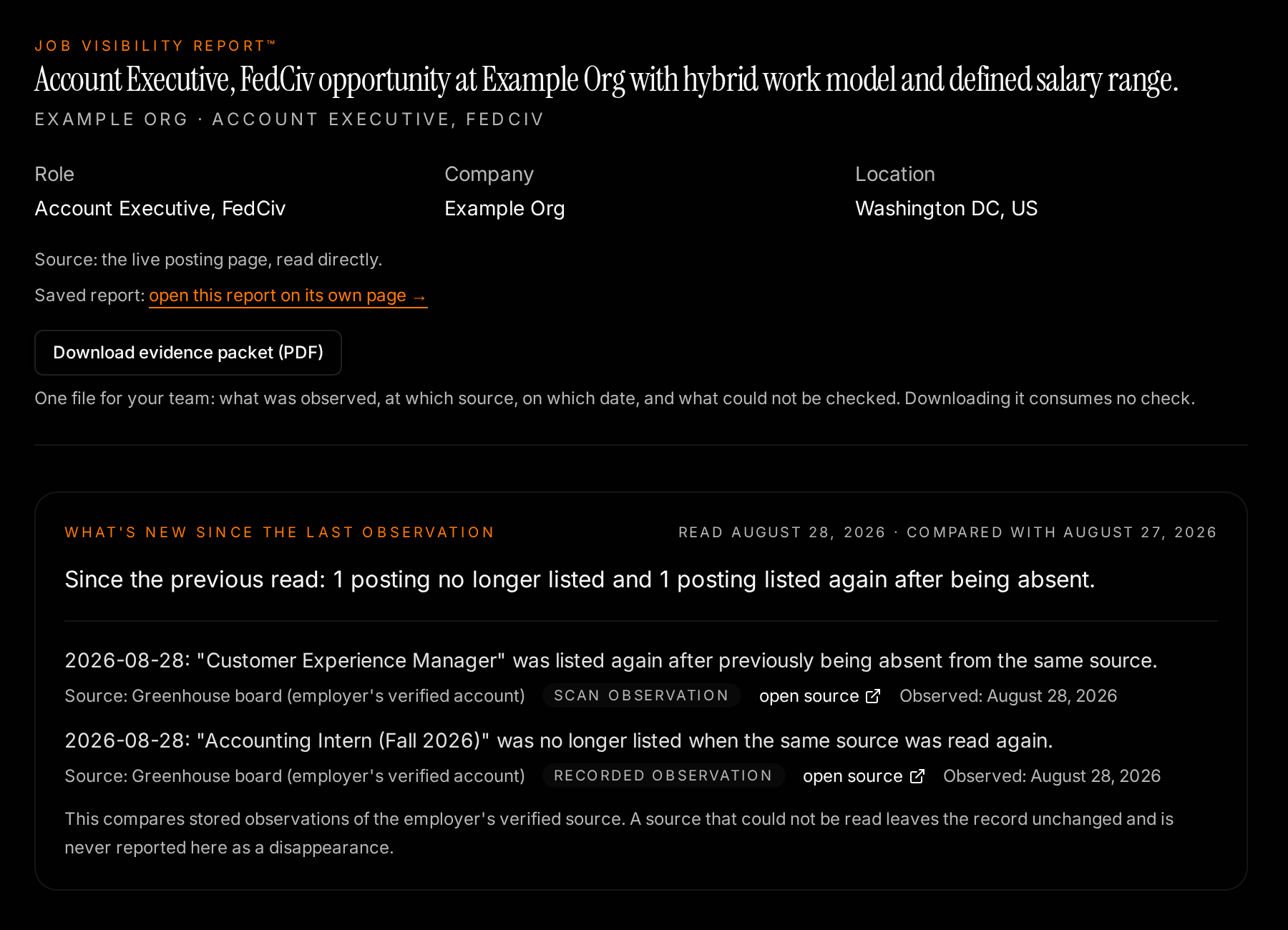
The organization's primary careers page, read in full and documented — the baseline, the sources observed, what differed, what changed, and the evidence behind each line.
An actual GhostPost.us report screen from a GhostPost.us field test. The observed organization is anonymized in this image. Not a customer engagement or endorsement.
Level 2 — The organization
Careers page, boards, and other configured public sources in one record: a summary first, then the detail behind every observed role, source and change. This is a broader, separately scoped engagement.
Field test
Organization scan · observation window 26–29 August 2026
One organization’s public job presence
Anonymized field-test organization. Every figure below is a fixed observation from that test, not a live reading.
Careers page
Scanned
Public sources observed
2
Roles tracked individually
29
Observations recorded
1,185
Roles visible on the first source
28
Roles visible on the second source
1
Roles that stopped appearing
5
Roles that reappeared
2
Source comparison — same organization, same day
First public source28 roles observed
Second public source1 roles observed
Discrepancies and compliance review
Evidence
The same organization showed 28 roles on one public source and 1 on another.
Review question
Reconcile the 27-role visibility difference against the intended public footprint and internal opening records.
Evidence
Five roles stopped appearing; two roles later reappeared.
Review question
Confirm whether each public status change was expected, approved, and consistently represented across sources.
Evidence
One role appeared on only one of the two observed sources.
Review question
Review whether required posting information and jurisdiction-specific disclosures were present wherever applicants could encounter the role.
End of field test record · figures are fixed observations, not a live feed
GhostPost.us Field Test — GhostPost.us’s own observation of public job sources. Not a customer engagement. Organizations are anonymized. Results reflect what GhostPost.us was able to observe at the time of the scan.
Compliance-related information, identified for review
A scan can surface the fields a reviewer may want to look at — compensation, location, requirements, and other applicable posting information — as they were publicly displayed.
Compliance-related information, as observed
Illustrative example — sample values shown to demonstrate the report format
Field
Careers page (baseline)
Job board
Board (second source)
Pay range displayedPay transparency rules turn on what the public posting displayed, not on what was in the requisition.
Found$118,000 – $141,000 / yr
Not availableNo pay field rendered on the page
Found$118,000 – $150,000 / yr
Location as displayedWhich jurisdiction's posting requirements a reviewer even has to consider depends on the displayed location.
FoundDenver, CO · Hybrid
FoundRemote — US
FoundDenver Metro
Benefits / other compensationSeveral jurisdictions require a general description alongside the range.
FoundMedical, 401(k) match, bonus target listed
Not availableNo benefits text present
Not availableSource truncates the description body
Requirements textDifferences in stated requirements across sources are the thing reviewers most often cannot reconstruct later.
FoundFull requirements section
FoundShortened — 3 bullets carried over
Not availableNo requirements section rendered
Posting availabilityWhether an advertisement was still publicly live is a question of dated observation, not recollection.
FoundLive
FoundLive
FoundRemoved, then returned 9 days later
Two plain states in the record: Found — the source displayed it, with the date and the source recorded. Not available — the information was not available from the source examined, which is never treated as a finding about the employer. Anything outside the selected Diagnostic scope is marked outside scope.
When each observation was taken
Mar 4, 2026 · 09:12 UTC
Baseline established from the careers page. Pay range and benefits observed.
Mar 4, 2026 · 09:14 UTC
Job board and second board copies observed. Pay range absent on the job board copy.
Mar 18, 2026 · 09:11 UTC
Second board upper bound changed from $141,000 to $150,000. Both states retained.
Apr 2, 2026 · 09:10 UTC
Second board copy no longer publicly reachable. Recorded as a disappearance, not a deletion.
Apr 11, 2026 · 09:13 UTC
Second board copy publicly visible again, with the March 18 values.
Each row is a dated, sourced observation. Earlier states are kept rather than overwritten, so what a source displayed on a given date remains readable afterwards.
Information identified for review
GhostPost.us surfaces what was publicly displayed, on which source, and on which date — including the fields a reviewer will want to look at, and the differences between sources.
Compliance determination
Not GhostPost.us. Whether a requirement applies, and whether it was met, is decided by the organization and its advisors. GhostPost.us never labels a posting compliant or non-compliant.
GhostPost.us provides the evidence. Your team decides what it means.
A posting that changes or disappears is not, by itself, a problem — the event may be entirely legitimate. The issue is whether anyone can see and document what changed.
Snapshot
One dated, sourced observation of what a public source displayed.
→
Change
The next observation shows something different — or nothing at all.
→
Recorded history
Both states are kept, in order, with the date and source of each.
A snapshot is evidence. A history makes change visible.
The question is: can anyone see and document what changed?
See
The posting disappears.
Senior Software Engineer · careers siteObserved
↓
Senior Software Engineer · careers siteNot found
Why it matters
The removal itself may be entirely routine. Without a record, the organization may not know exactly when it stopped appearing, what was publicly displayed beforehand, or how it appeared across other sources.
With GhostPost.us
A dated, sourced record of what was visible before the change, and when it was last observed.
See
The posting changes.
Senior Software Engineer · $120K – $150KObserved
↓
Senior Software Engineer · $130K – $160KChanged
Why it matters
Changes to publicly visible employment information can matter when recruiting, legal, compliance, or leadership teams need to understand what the public could see.
With GhostPost.us
The change is part of the record, with both states preserved and timestamped.
See
Different sources. Different views.
Board A · 28 roles observedObserved
↓
Careers site · 1 role observedDiffers
Why it matters
An organization does not control how every public source presents its roles. What one source shows may not be what another shows on the same day.
With GhostPost.us
Each source is recorded separately, so the difference is observable rather than assumed.
One record. Four lenses.
The same underlying evidence, read through the perspective most relevant to the question being asked. The evidence does not change. The perspective does.
Market-wide employer postings and external recruiter marketplace ads.
What the record holds
A record of which accounts have active postings, with the date last observed.
The problem today
Third-party copies and reposted listings can make true hiring velocity hard to read.
What the record makes possible
Filter out third-party noise and identify accounts with active postings.
Regulatory context
Public job-posting disclosure requirements now exist in a growing number of jurisdictions, and the details differ in what must be disclosed, who is covered, how remote roles are treated, and whether there is a period to correct a covered posting after written notice.
United States — status by state
Hover a state for its status
AK
ME
VT
NH
WI
MI
NY
MA
RI
WA
ID
MT
ND
MN
IL
IN
OH
PA
NJ
CT
OR
NV
WY
SD
IA
MO
KY
WV
VA
MD
DE
CA
UT
CO
NE
KS
AR
TN
NC
SC
DC
AZ
NM
OK
LA
MS
AL
GA
HI
TX
FL
Current / In force
Pending / Proposed per the source
No statewide requirement identified
22
Jurisdictions with a requirement identified as in force
3
Enacted, with an effective date still ahead or unset
3
Pending or proposed according to the source
Counts reflect the entries in the GhostPost.us requirement map for the United States and Canada, each with its source and the date it was last verified. GhostPost.us does not score jurisdictions or state whether any organization meets a requirement. Specific developments are tracked on The GhostPost.us Signal.
GhostPost.us’s own observations of public job sources. Organizations are anonymized and every figure comes from the observation record.
Field test
GhostPost.us Field Test — GhostPost.us’s own observation of public job sources. Not a customer engagement. Organizations are anonymized.
Field test 1 of 3 · 11 September 2026
Field Test: One employer, three state disclosure contexts
Public source observed
One employer-operated job board
Current board openings
176
States reviewed
Colorado, California, New York
Posting records reviewed in detail
Three
Current state requirement sources cited
Three official sources
What we observed
One public employer board listed roles reaching Colorado, California, and New York. The California posting displayed a numeric base-pay range. The New York posting displayed a numeric salary range. A multi-location talent-community posting that named Denver, Colorado displayed benefits and the phrase “competitive salary with equity,” but no numeric range. Application-deadline language was not found in the three posting records reviewed.
What became visible
The same employer's public template presented compensation differently across state-linked postings.
The Colorado-inclusive posting named Denver alongside other locations, so applicability cannot be inferred from the location string alone.
Each reviewed item is tied to its exact public posting text, source, and observation date.
Discrepancies and compliance review
Confirm whether the multi-location talent-community posting represented an opportunity that could be performed in Colorado.
If Colorado rules apply, review whether “competitive salary with equity” supplies the compensation information required by the organization's applicable rules.
Review whether the benefits language supplies the general description required for the posting type.
Confirm whether an application deadline was required and, if so, whether it appeared anywhere in the applicant-visible posting surface.
Verify the California and New York ranges against the approved internal compensation record and the current statutory definitions.
Why it matters
One publishing template can expose an organization to different disclosure requirements at the same time. GhostPost.us preserves the exact public language and connects it to official requirement records so legal and compliance teams can review the difference before an inquiry, complaint, or enforcement action.
Field test 2 of 3 · 26–29 August 2026
Field Test: Two public sources, one organization
Observation window
Four days
Public sources observed
Two, both associated with the same organization
Roles visible on the first source
28
Roles visible on the second source
1
Observations recorded
1,185
What we observed
Two public sources associated with the same organization were read repeatedly over four days. One source displayed 28 publicly visible roles. The other displayed one.
What became visible
The two public sources presented materially different views of the same organization's public job presence.
Every role on each source carries the date and time it was observed and the source it was read from.
Reading one source alone would have produced a defensible but incomplete picture of what the public could see.
Discrepancies and compliance review
Reconcile why one public source displayed 28 roles while the other displayed one.
Confirm whether required posting information remained consistent across every source where a role appeared.
Determine which source represented the organization's intended public hiring record on that date.
Why it matters
An organization looking at one public source is not looking at its public footprint. The difference between two sources is only visible when both are observed and recorded side by side.
Field test 3 of 3 · 26–29 August 2026
Field Test: What four days of repeated observation showed
Observation window
Four days
Roles tracked individually
29
Role appearances recorded
29
Roles that stopped appearing
5
Roles that reappeared after being absent
2
What we observed
Repeated reads of the same public sources produced a continuously updated record of which roles were publicly visible, and when. Every change below is an individual event in the record, with the role followed by its own identifier rather than counted in a total.
What changed, and when
26 August, 03:12A customer-experience role that had been publicly visible since the first read stopped appearing on the source.
26 August, 03:23The same customer-experience role appeared again 11 minutes later, after 6 recorded observations.
26 August, 03:23A separate public-sector sales role was observed exactly once, then stopped appearing and did not return during the window.
26 August, 04:21The customer-experience role stopped appearing a second time and remained absent for the rest of the window.
27 August, 13:19A second customer-experience role, publicly visible since 26 August across 35 observations, stopped appearing.
28 August, 01:21That role appeared again after roughly 12 hours of absence.
28 August, 01:21A finance internship role, the only in-office role tracked, stopped appearing after 37 observations and did not return.
What became visible
Individual roles could be followed over time rather than counted once — the same role disappearing twice is two recorded events, not one.
A role can leave and return within minutes; without repeated observation that round trip is invisible entirely.
One role was publicly visible for a single observation before it stopped appearing.
A read that failed was recorded as a failed read, separately from a role that was genuinely no longer displayed.
Discrepancies and compliance review
Reconcile each disappearance and return with the approved opening status and internal system of record.
Review whether a role's required public information remained consistent before and after it returned.
Preserve the dated evidence needed to explain what applicants could see at each point in time.
Why it matters
A single snapshot can tell you what was visible. Repeated observation can show you what changed — and it can surface that change while there is still an opportunity to review it.
End of field test record · figures are fixed observations, not a live feed
GhostPost.us for Individuals
A separate, secondary experience with the same evidence rules. It is not part of the organizational product.
Want to understand a job posting from your perspective?
GhostPost.us observes and documents. It does not make the decision for the organization.
GhostPost.us observes and documents what it can verify from configured public sources. It surfaces evidence; the people responsible for legal, compliance, policy, employment, and enforcement decisions determine what that evidence means and what action, if any, is appropriate.
Coverage depends on the sources GhostPost.us is configured and technically able to observe.
Want a broader view?
Interested in a larger footprint — aggregators, historical look-back, additional career platforms beyond your primary page? Contact us at info@phoxxydata.com.
You can't manage what you can't see. You can't defend what you can't document.
GhostPost.us gives your organization the visibility record needed to understand what was publicly visible and to make informed decisions. We observe. We preserve. You decide.